
Arrest History in Lee County
Lee County arrest records begin with the agency that takes a person into custody. That may be the Lee County Sheriff's Office, Auburn Police Department, Opelika Police Department, ALEA Highway Patrol or State Bureau of Investigation, Phenix City Police, or another agency with authority in the county. Smiths Station has no separate police department identified in the official research, so its city channels route residents to the Sheriff. Auburn University arrest records also belong with Auburn Police because the university's sworn policing merged into APD in 2004.
Booking creates a second record. The Lee County Detention Facility records intake identity, booking time, charge and bond data, fingerprints, and a photograph. Prosecutors may later change or decline the initial charge, while the clerk records any filed case and outcome. ALEA receives fingerprint-linked arrest submissions and later reported dispositions. No one source is a complete Lee County arrest history, and the Sheriff does not publish a stated historical reach for its current and recent lists.
Search Lee County Recent Arrests
The Sheriff's free Recent Arrests interface and current inmate roster are card lists with one “Type to Search” box, pagination, and sorting. They do not offer separate filters for birth date, agency, charge, date range, or custody status. Use enough identifying detail to avoid mixing people with similar names, then confirm the booking through another official source.
The official recent-arrest screen shows how the local tool is organized.
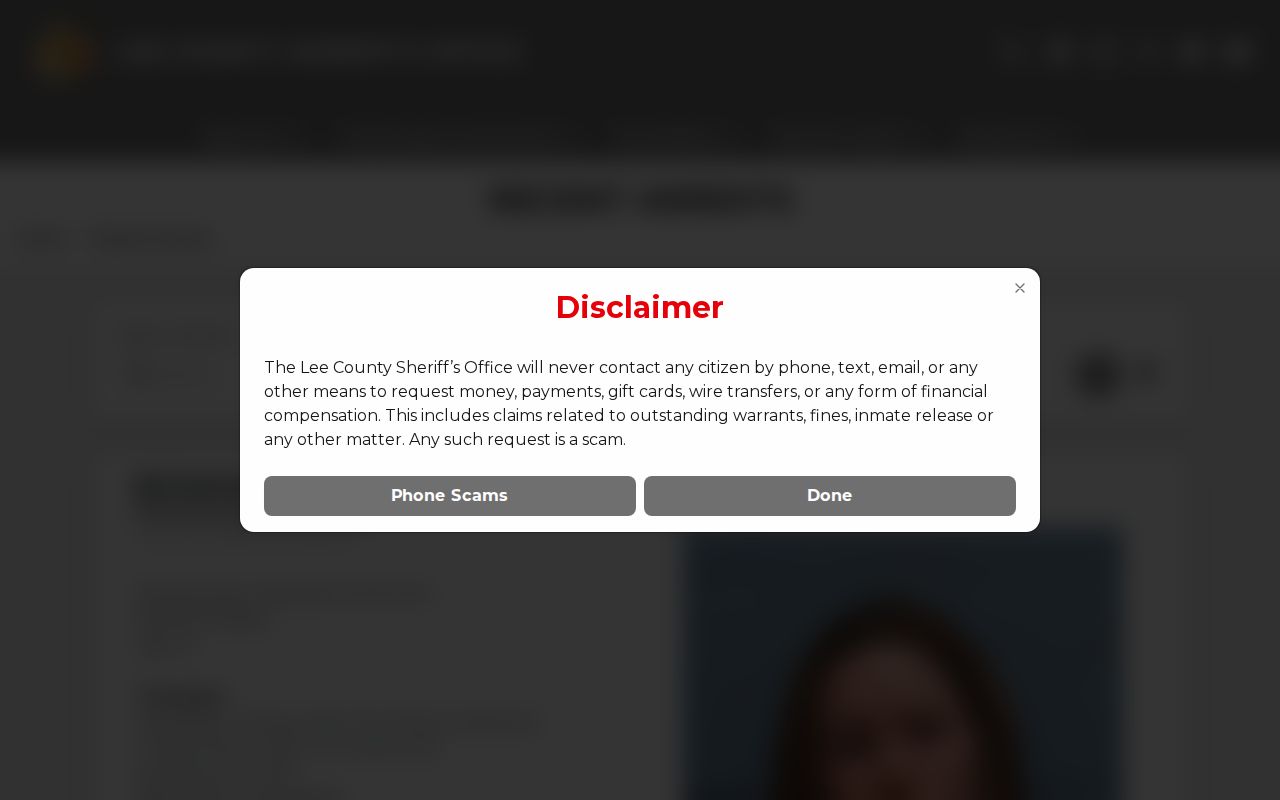
The interface is a route to recent booking data, not a gallery and not proof that a listed charge led to prosecution.
Note: A person who no longer appears in current custody may still have a recent booking, agency report, court file, or ALEA arrest cycle.
How to Look Up Lee County Arrests
A channel-complete search follows the record from intake to disposition. Online results can fail because a person was released, transferred, booked under a different name form, or never entered in that system. Keep the date, location, agency, and known name variants at hand. Use this order:
- Search the Sheriff's Recent Arrests list, then the current Inmate Search. Call the jail at 334-737-7050 or the Sheriff's main line at 334-749-5651 when either tool fails.
- Request the arrest or incident report from the agency that created it. For a Sheriff record, use the Central Records counter or the official GovQA request system.
- Match a filed charge in Just One Look or ask the correct Circuit, District, or municipal clerk. The court file supplies the formal charge and disposition that the booking card lacks.
- For your own statewide identity-linked history, submit ALEA Form 46 with fingerprints, current photo identification, and the required payment. Alabama has no unrestricted public name search of its repository.
- Use VINELink for custody or release alerts, the ADOC locator after transfer to state prison, and the BOP locator for federal custody. These custody tools do not replace the arrest report.
The Lee County Sheriff GovQA Public Records Center accepts categories that include local checks, offense and traffic-crash reports, calls for service, and public requests.
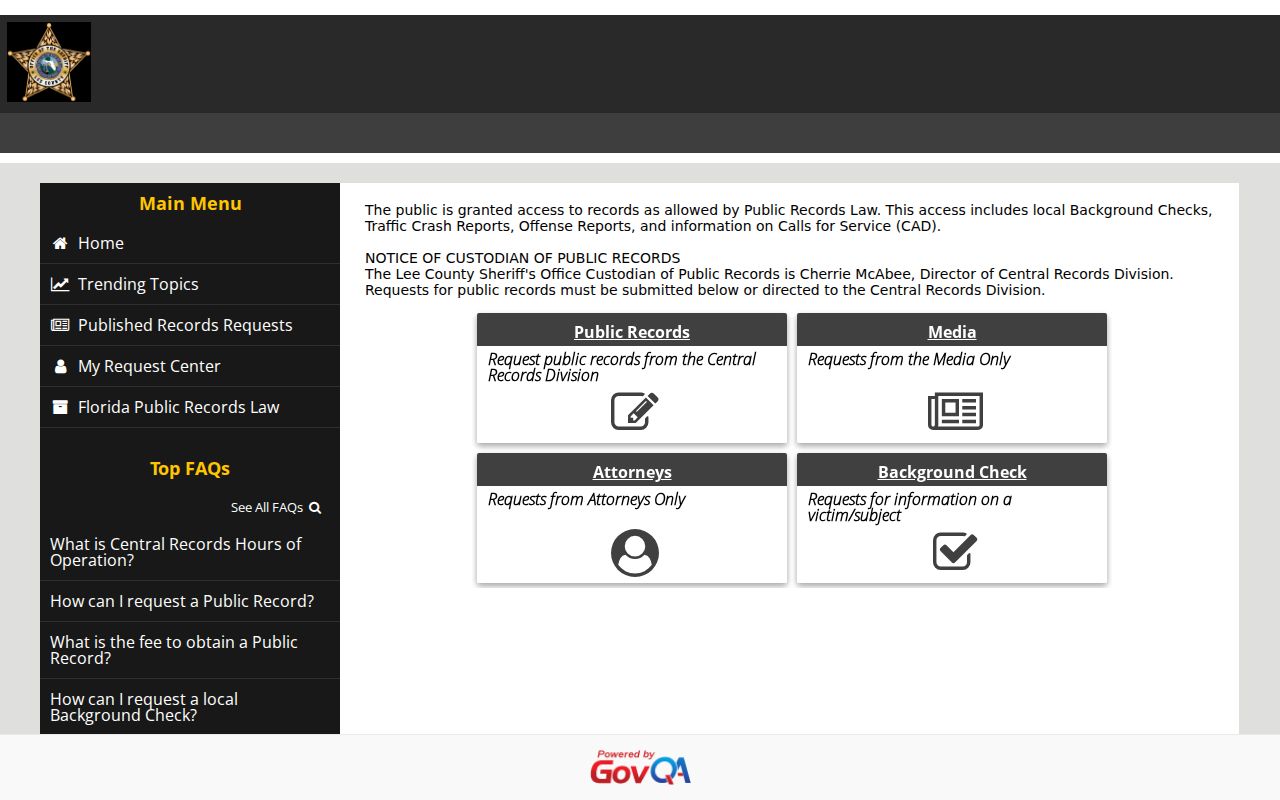
GovQA is the formal fallback for a Sheriff-created record when the booking lists do not answer the request.
Lee County Arrest Report Custody
The creating agency holds its own incident or arrest report. Lee Sheriff records start at 1900 Frederick Road in Opelika. Auburn Police directs report requests through its records process, while Opelika Police Records serves routine approved reports at its 501 South 10th Street counter. Opelika lists a $10 basic-report charge and requires identification and qualifying party status. ALEA keeps its own Highway Patrol and SBI records. A Phenix City matter starts with that city's official court or police channel.
| Arresting Agency | Official Records Route |
|---|---|
| Lee County Sheriff | Central Records counter, main phone, and GovQA request center. |
| Auburn Police | Auburn Police records and service channels; records at 141 North Ross Street, 334-501-3100. |
| Opelika Police | Opelika Police Records and Reports; 501 South 10th Street, 334-705-5295. |
| ALEA Highway Patrol or SBI | The creating state unit keeps its record through ALEA DPS or ALEA SBI. |
| Phenix City Police | Use the official Phenix City court channel to identify the correct city record route. |
| Smiths Station | No separate city police department was identified; use Lee County Sheriff channels. |
Lee County Sheriff Central Records
W.S. Jones Center
1900 Frederick Road
Opelika, AL 36801
334-749-5651
Monday through Friday, 8 a.m. to 5 p.m. Central
Ask for the precise product. An arrest report, jail booking record, warrant, and court case-action summary are held by different custodians. The Sheriff's corrections information page supplies the county custody route.
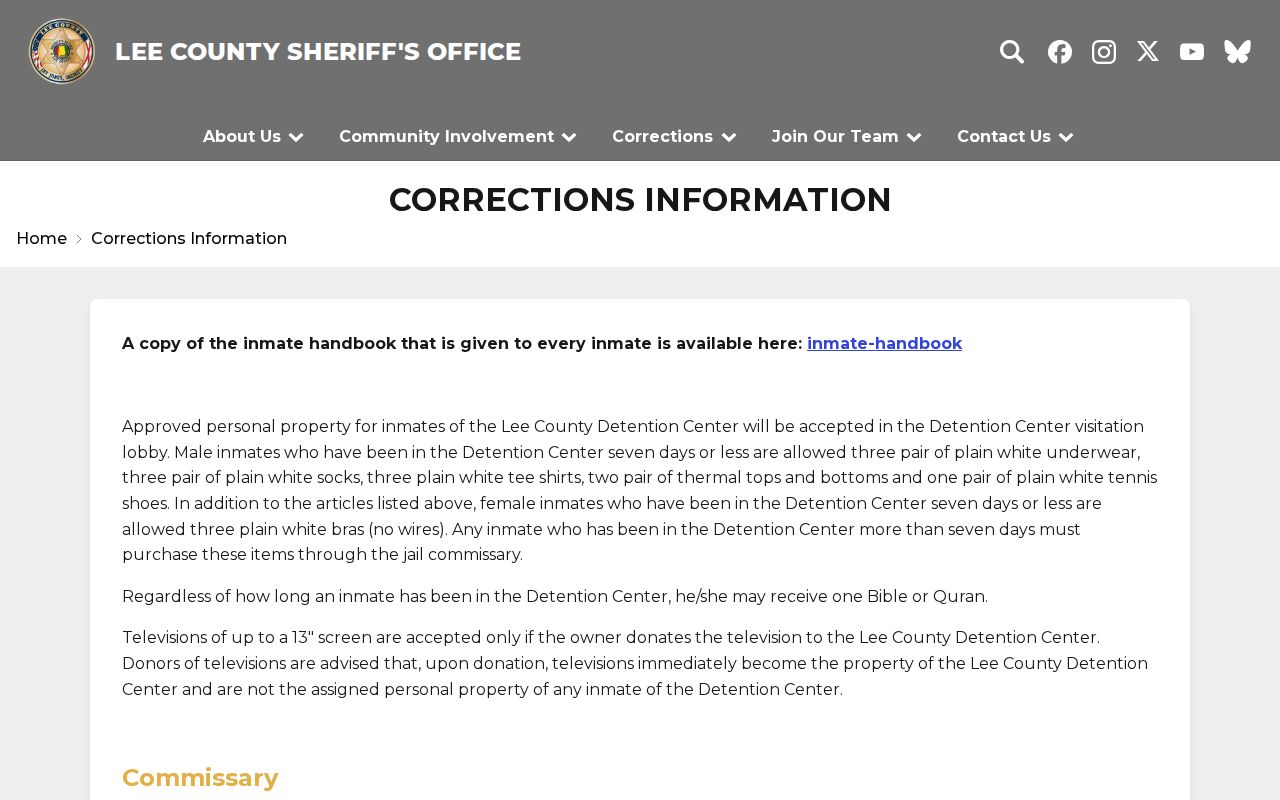
Corrections information helps locate jail services, but the arresting agency remains the source for its report narrative.
What an Arrest Record Shows
A full agency report can include an incident number, time and place, agency and officer, subject identifiers, the alleged offenses, probable-cause facts, evidence, and warrant details. Protected victim, witness, or investigative information may be redacted. The public Lee inmate card is far narrower.
| Identity | Profile title, numeric NameID, age, and one-letter race and sex codes. |
|---|---|
| Booking Date and Time | The intake event shown on the Lee County public profile. |
| Charge Description | Initial booking wording, which can differ from the later filed charge. |
| Charge Status | Status displayed for each repeated charge block. |
| Bond | Amount and bond status shown for each listed charge. |
| Booking Photograph | The official profile displays one, but no photograph or identity is republished here. |
| Fields Not Observed | No DOB, arresting agency, statute, warrant number, court date, release date, or cell assignment was observed. |
The missing fields matter. Take the booking date and charge wording to the agency or clerk rather than treating a profile as a full criminal-history record.
Lee County Warrant Arrest Fallback
Lee County does not publish a verified active-warrant search. The magistrate's official guidance says an arrest warrant is not public until it has been served. A person who suspects an outstanding warrant should appear at the Sheriff rather than rely on a roster no-match. The Sheriff's main line is 334-749-5651. Clerk fallbacks include E-Warrants at 334-737-3501 and juvenile or over-the-counter warrants at 334-737-3553.
City court contacts can help route Auburn matters at 334-501-3180, Opelika matters at 334-705-5190, and Phenix City matters at 334-448-2780. After service, request the warrant through the Lee Clerk's records form or follow the filed case in Just One Look. Sealed, unserved, and juvenile warrants remain restricted. The Sheriff app did not expose a verified active-warrant search during research.
Lee County Booking Charge Timeline
The operational path is: arrest report → jail intake → fingerprint submission → prosecutor review → filed court charge → hearings and disposition → report back to ALEA. Custody staff identify and search the person, document property and holds, capture fingerprints and a photograph, and begin classification and medical screening. Bond status can change after judicial review.
Alabama Rule of Criminal Procedure 4.3 requires probable-cause review within 48 hours after a warrantless arrest and an initial appearance within 72 hours for an unreleased person. Those deadlines concern early review, not final guilt. Release ends local custody. It does not erase the report, booking entry, court case, or reported ALEA cycle. The filed case can be followed through the Lee County criminal court records when charges reach a clerk.
Recent Arrests and Booking Logs
The official Lee County Inmate Search serves current custody, while Recent Arrests can retain a newer booking after release. Neither tool is a statewide or lifelong arrest history. The inspected interface uses one type-to-search field, cards, and pagination.
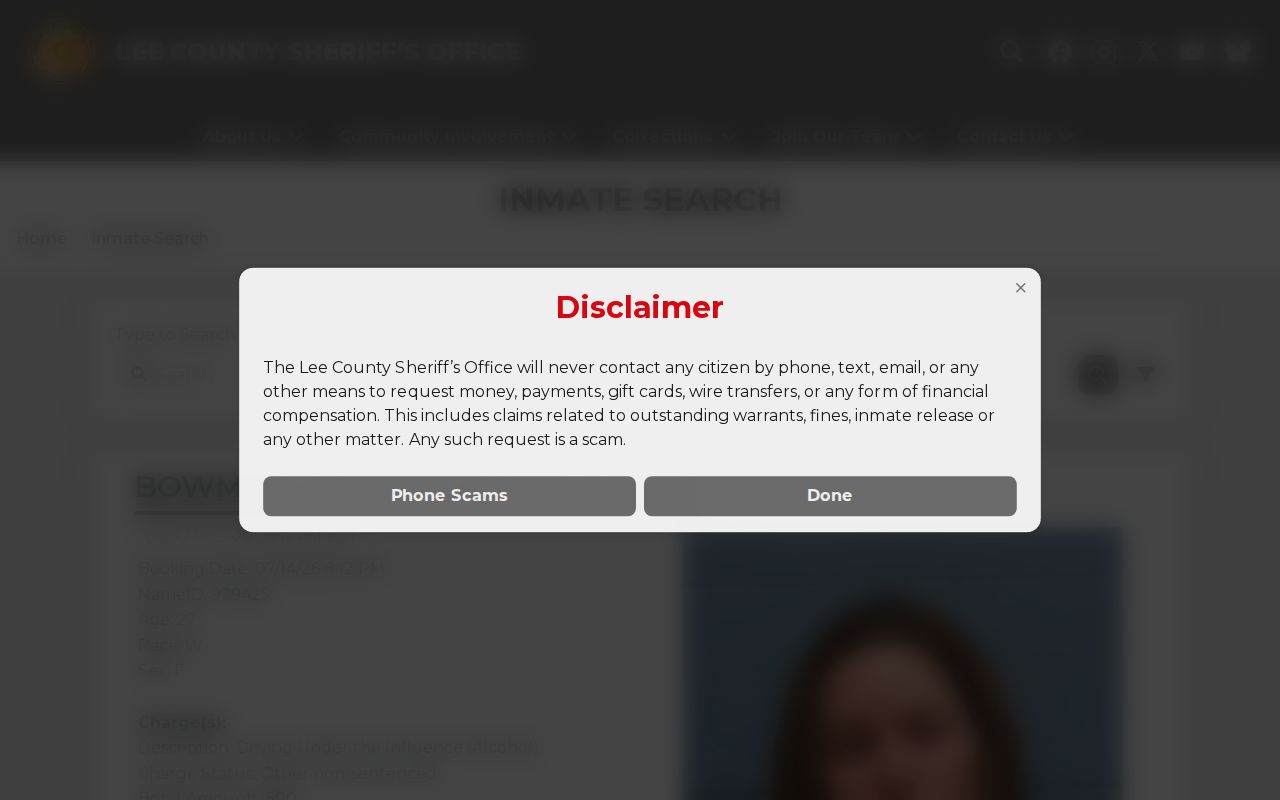
The current roster is best for a person who may be held locally now, not for proving that no earlier Lee County arrest exists.
VINELink provides notification rather than a certified arrest record. After a sentenced person moves to state custody, use the ADOC Inmate Search.
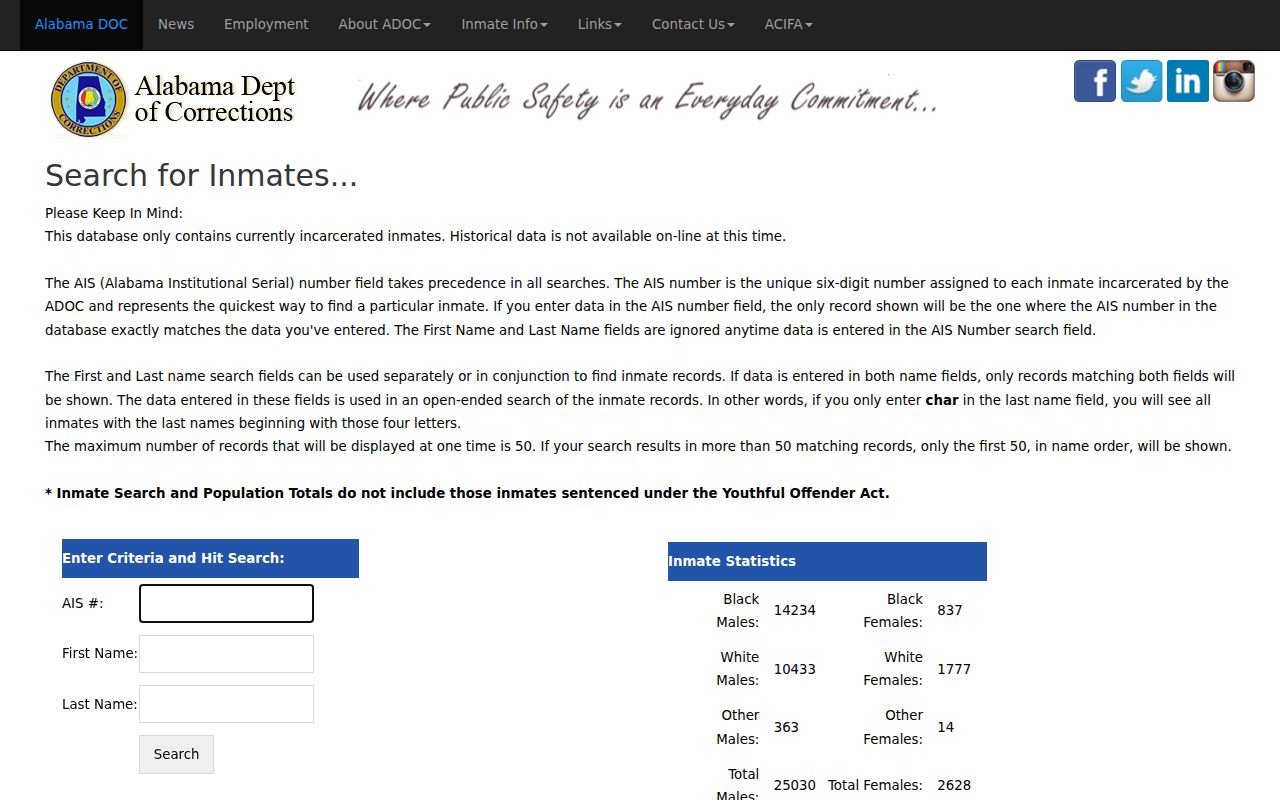
ADOC limits online results to its current incarcerated population, excludes Youthful Offender cases, and does not publish historical custody data online.
Lee Arrests Beyond County Custody
A no-match in the county roster may mean release, transfer, a federal case, or a search mismatch. State custody belongs in ADOC's current locator. Historical state incarceration requires another ADOC records channel because the public tool does not supply it. Federal arrests and cases belong to federal agencies and the U.S. District Court for the Middle District of Alabama, not the Lee Sheriff roster.
The official Federal Bureau of Prisons locator is the custody channel for a person in federal prison.
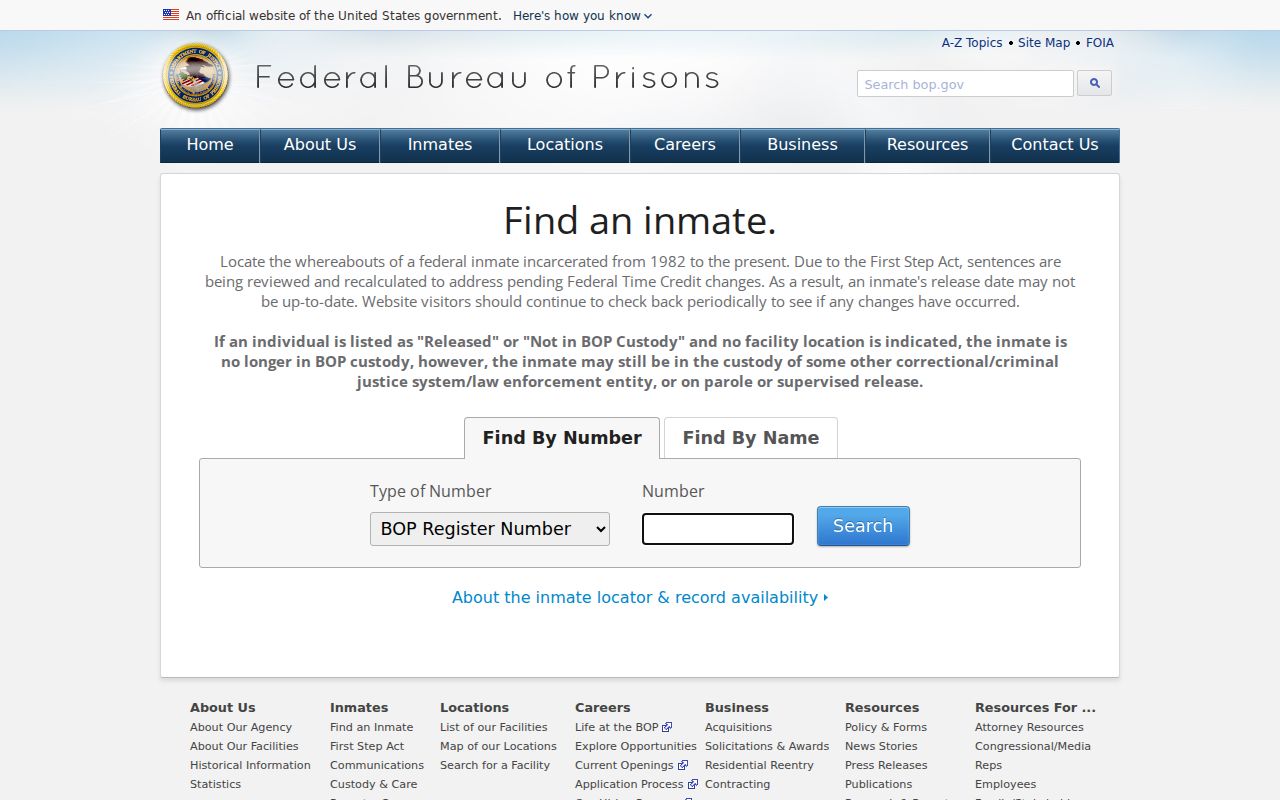
BOP custody data does not supply the Lee County agency report or the federal docket; PACER and the federal court are separate record channels.
Arrests vs Convictions
An arrest proves that a custody event occurred. It does not establish that a prosecutor filed the same charge, that the case reached trial, or that a court entered guilt. A conviction is the court's judgment. ALEA's identity-linked CHRI can pair a reported arrest cycle with a later disposition, but reporting lag or an unmatched result can leave a gap. An individual can use ALEA's fingerprint review and challenge process to address an inaccurate state entry.
| Arrest Record | Conviction Record |
|---|---|
| Created by an arresting agency and, after intake, the jail. | Created by the court after a plea or finding. |
| Shows an alleged offense and custody event. | Shows a judgment of guilt and its sentence. |
| Held by the agency, Sheriff booking system, and reported state repository cycle. | Held in the clerk's case file and reported to ALEA. |
| May lead to no charge, dismissal, acquittal, or conviction. | May lead to sentence, appeal, or qualifying expungement relief. |
Note: An arrest is not proof of guilt; the charge may never be filed or may end in dismissal or acquittal.
Correcting Lee County Arrest History
A person reviewing their own Lee County arrest history may find that a disposition is missing or does not match the court result. ALEA Form 46 provides the fingerprint-based review and challenge route. The challenge asks for the date, arresting agency or court, disputed charge or disposition, the correction sought, and official proof. Start with the Lee Circuit Clerk when the needed proof is a judgment, dismissal, indictment, or case-action summary.
Expungement is a court process, not an edit that ALEA can grant. Alabama's CR-65 petition requires the case number, offense, code section, arresting agency, arrest date, disposition, eligibility ground, prior Alabama expungement history, and sworn verification. Lee County states a $500 filing fee unless indigency is found. One fee may cover charges from one arrest, while separate arrests require separate fees.
Service is crucial. A qualifying petition may need to identify the district attorney, police chief, sheriff, ALEA, Circuit or District clerk, municipal clerk, and another record holder. An Auburn or Opelika arrest can leave records with city police, the Frederick Road jail, a city or county court, and ALEA. After an order, keep certified copies. If the state entry remains wrong, use the ALEA challenge route with the order as proof.
Lee Sheriff Arrest Tools App
The official Lee County Sheriff's Office Alabama mobile app advertises routes for inmates, recent arrests, corrections, visitation, records requests, case status, tips, news, alerts, victim notification, and sex-offender information. It is available through Apple's App Store and Google Play. Research did not verify any arrest feature as app-only, so the web, phone, and counter routes remain valid fallbacks.
The app can group official Lee County arrest tools in one place, but each linked product keeps its own scope. A roster still answers current custody. A records request still seeks the report. A clerk search still establishes the filed charge and final result.