
How to Check Criminal History in Opelika
Choose the record before choosing the office. OPD's basic report gives limited incident information. A complete investigative file has stricter approval and timing rules. Opelika Municipal Court supplies its own local case documents. Lee County systems answer jail custody and county-court questions, while ALEA's fingerprint process is for reviewing one's own statewide criminal-history information.
- Take the case number, date, location, involved names, identification, and party status to Opelika Police Records for a routine report.
- Use the city's NextRequest process only for general city records that are not routine police reports supplied by OPD Records.
- Send a written request to Opelika Municipal Court for a local traffic, ordinance, adopted misdemeanor, warrant, or probation file.
- Use the Lee Sheriff roster and Circuit Clerk when the event produced a county booking, felony, or other county case.
- Use ALEA Form 46 with fingerprints and identification to review your own Alabama criminal history.
A result from one channel does not replace the others. It reflects only the stage and records that office controls.
Opelika Police Report Counter
Opelika Police Records operates at 501 South 10th Street. The records number is 334-705-5295, the department main number is 334-705-5200, and counter hours are Monday through Friday from 8 a.m. to 5 p.m. Give the case number if known, plus the incident date, location, and involved names. Proper identification and the requester's connection to the event matter for release.
The official OPD Records and Reports page documents the access rules pictured here:
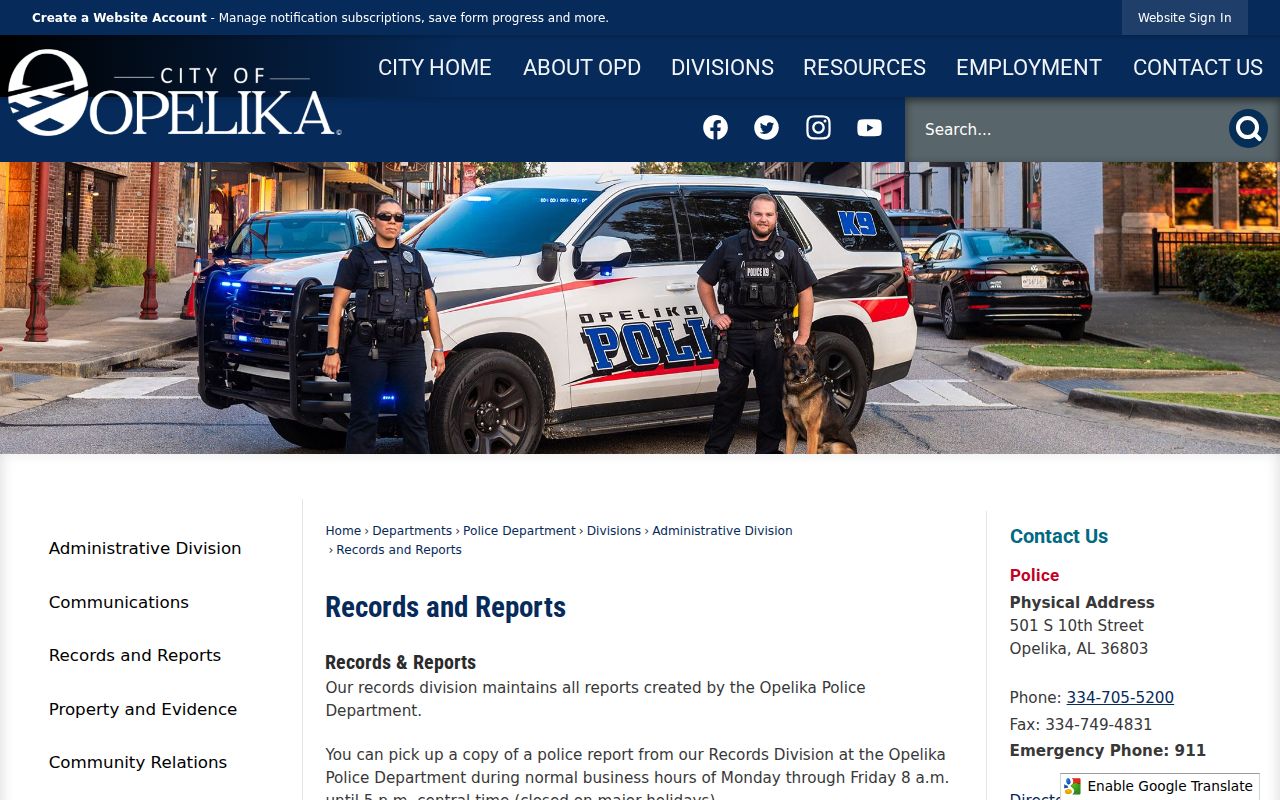
The police counter is the city's direct route for ordinary incident, offense, and accident reports to eligible involved parties.
The Opelika Police Department
OPD keeps the report created by its officers. It does not keep every later record produced from an arrest. A released basic incident report is limited to first-page or basic information, and the requester must be the reporting person, victim, or offender with proper identification. A more complete investigative file requires approval. It cannot be released while the matter remains under active investigation or pending in court.
Those limits explain why a counter denial may be about timing or content, not the existence of an incident. Protected victim details, investigative material, and records held by another office can also affect the response. When a case has moved to court, request the filed charge, docket, orders, and disposition from the correct clerk. For present custody, use Lee County jail channels.
Note: An OPD report shows the police event; it does not establish the final charge or prove a conviction.
Opelika Police File Fees
Opelika publishes a detailed police schedule. A basic report costs $10 and can be paid by credit card, cash, or money order, but not by check. An approved case file costs $2 per page. Photographs cost $25 per disc, video or audio costs $25 each, a CDR download costs $50 per vehicle, and a crime or accident scene scan costs $150 per scan.
| OPD product | Confirmed fee |
|---|---|
| Basic police report | $10 |
| Approved case file | $2 per page |
| Photographs | $25 per disc |
| Video or audio | $25 each |
| CDR download | $50 per vehicle |
| Scene scan | $150 per scan |
Under the complete-file rule, the purchase includes requested photos, recordings, scans, and CDR material. It is not a menu for selecting isolated fragments from a complete investigative file. Approval and the active-case restriction still apply before price becomes the key issue.
Arrests and Bookings in Opelika
OPD arrestees are booked at the Lee County Jail on Frederick Road rather than a separate city jail. OPD creates the arrest report. Jail staff create the intake record, take fingerprints and a booking photograph, enter charge and bond information, and track custody. The Lee Sheriff roster displays booking time, NameID, age, race and sex codes, charge description and status, and bond amount and status.
Search Recent Arrests first for a new Opelika booking, then the current Inmate Search. Call the jail when the official portals do not answer a present-custody question. Ask OPD for the police narrative. Follow a city charge at Municipal Court or a felony and county charge at the Circuit Clerk. The roster does not show the full report, prosecutor's final charging choice, or judgment, so it should never be read as a complete criminal history.
NextRequest or Opelika Police Records
Opelika uses two request tracks. The citywide NextRequest portal is the preferred channel for general municipal records. The 2024 city policy names the City Clerk as Public Records Officer and allows requests by hand, mail, email, or portal. Routine police incident, offense, and accident reports for involved parties may bypass that process and go straight to OPD Records.
The official portal interface is shown below, but its client-side field list was not verified:
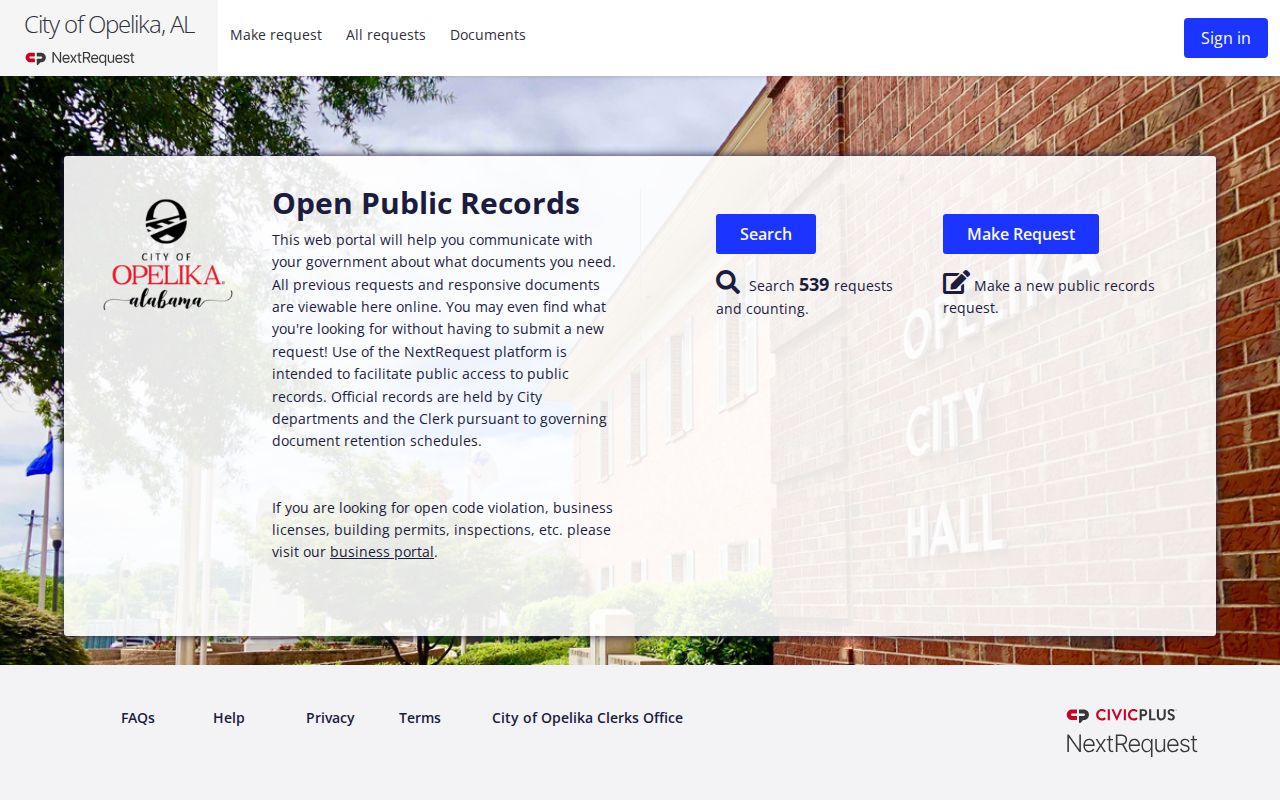
Do not invent portal inputs or send a routine police request into the general queue merely because both routes involve the city. Use the record type to choose.
Opelika Municipal Court Records
Opelika Municipal Court is at 300 Martin Luther King Boulevard, with phone service at 334-705-5190. The office is open weekdays from 8 a.m. to 5 p.m., and court meets Wednesdays at 9 a.m. and 1 p.m. It handles city traffic and ordinance matters, adopted misdemeanors, warrants, and municipal probation. No public name or case-search portal was found.
The official municipal copy policy supplies the request rules illustrated here:
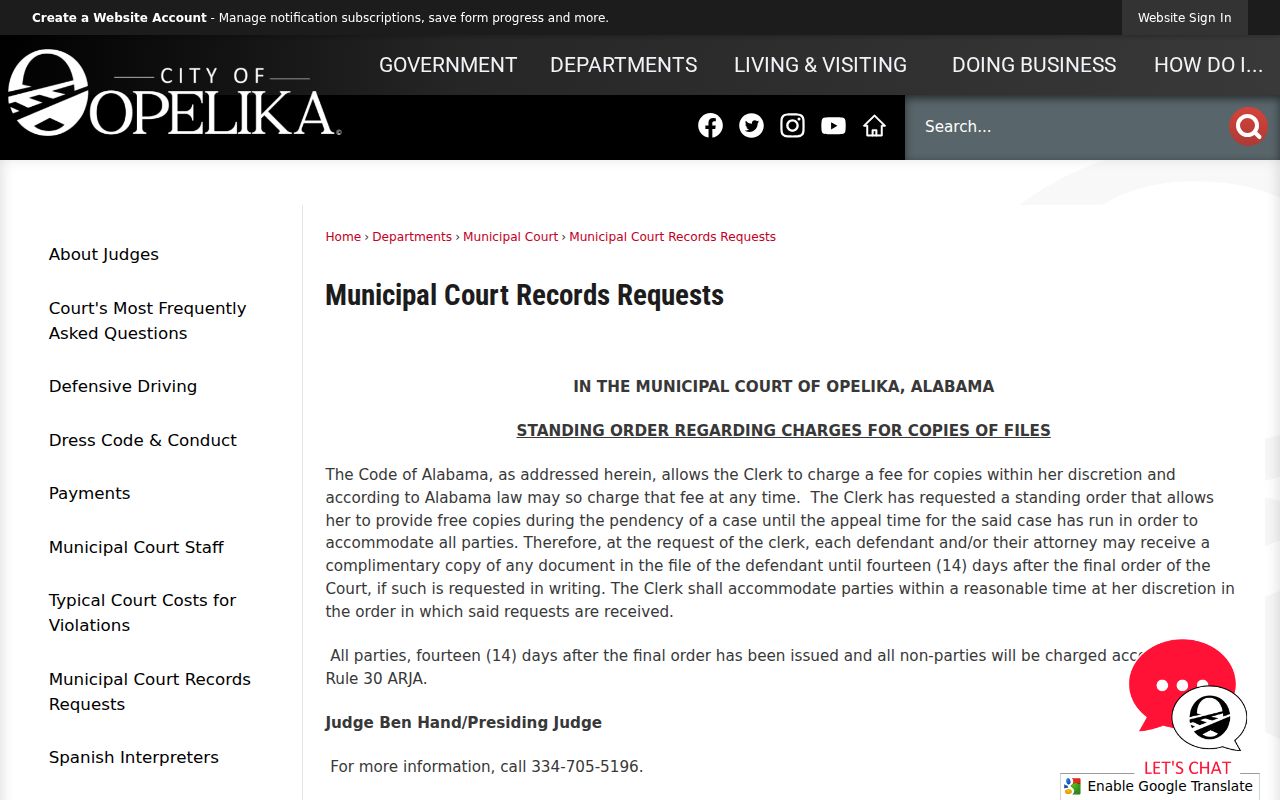
The court keeps local case documents, not OPD's investigative file or the jail's booking card.
| Court Name | Opelika Municipal Court |
|---|---|
| Case Types Heard | Local traffic, ordinance, adopted misdemeanor, warrant, and municipal probation matters |
| Case Lookup Channel | Written request, clerk counter, or phone; no public search portal found |
| What the Docket Shows | City charge, settings, orders, disposition, sentence, and public financial entries |
| Copies & Fees | Defendant or attorney copies are complimentary while pending and through 14 days after final order; later and nonparty requests use Rule 30 rates |
Opelika Court's Copy Window
A defendant or attorney may request complimentary municipal documents in writing while the case is pending and through fourteen days after the final order. After that period, and for all nonparty requests, Alabama Rule of Judicial Administration 30 copy charges apply. The timing turns a simple request into a paid one, so note the final-order date before asking.
This rule applies to Municipal Court documents. It does not make an OPD investigative file free, alter police party-status limits, or set Lee Circuit Clerk charges. A request should name the defendant, case or citation number if known, the document sought, and contact information. If a missed appearance or citation question is current, call the municipal clerk instead of relying on a copy request to resolve the case status.
Where Opelika Records End Up
An OPD event can generate records at several offices within the county seat. Police maintain the incident or arrest narrative. Booking at Frederick Road creates the county custody record. Opelika Municipal Court keeps a qualifying city case, while Circuit or District Court keeps a county case. Fingerprints and arrest-cycle data reach the Alabama Law Enforcement Agency, and courts later report dispositions for matching.
Record flow: Opelika Police Department › Lee County Courts › Alabama Law Enforcement Agency
A recent report may appear before charges are filed. A booking card may retain the intake wording after the prosecutor changes the charge. A judgment may take time to match to state CHRI. Compare records by date, agency, and case number rather than assuming one source is complete.
Opelika's Two Court Systems
Opelika is the county seat, but its municipal court and Lee County courts are not one office. The municipal building holds local city matters. The T.K. Davis Justice Center holds Circuit and District files. Circuit Court is the felony court. District Court handles ordinary county misdemeanors, traffic, and felony preliminary hearings subject to exceptions.
The official police and Municipal Court location source shows the city access point:
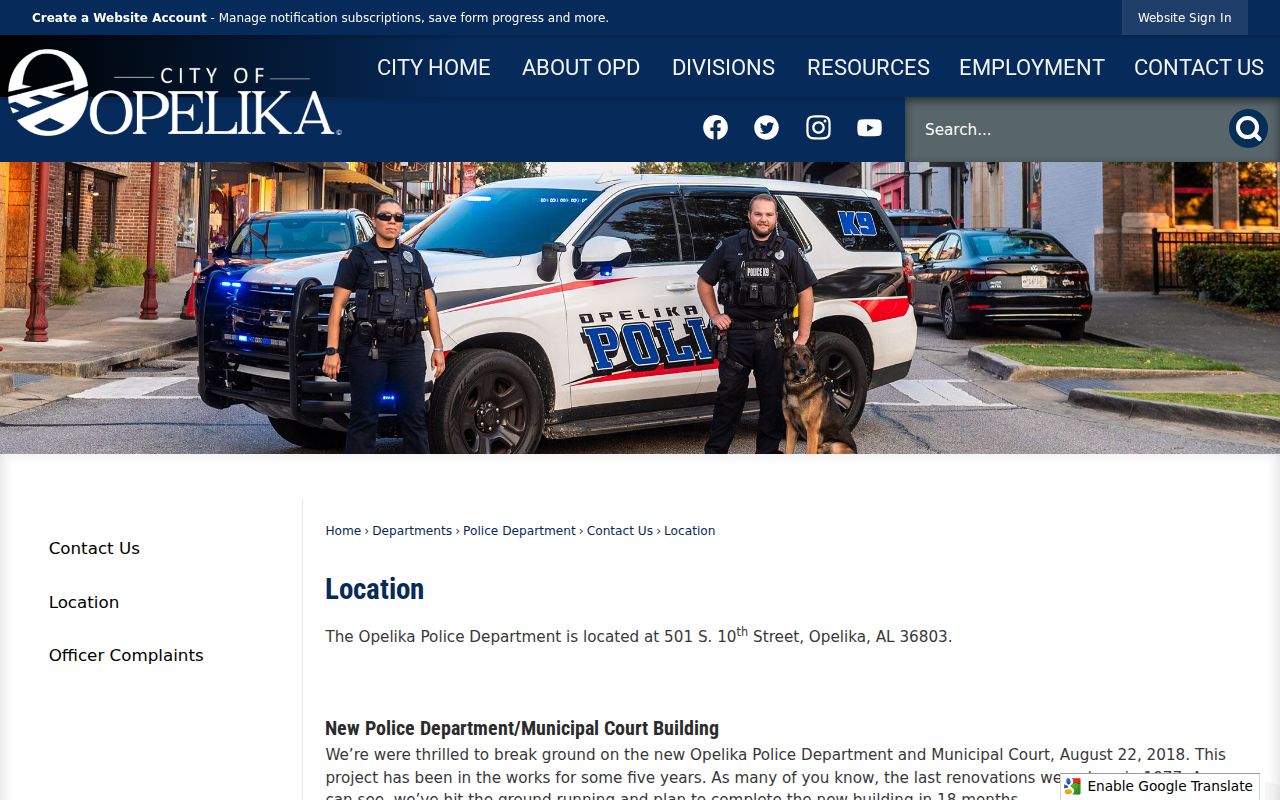
A city building address on a citation signals the municipal route. A Lee County court number or felony charge signals the Circuit Clerk at the Justice Center.
Reading Opelika Criminal Records
An Opelika police report may include an incident number, date and time, place, officer, initial allegations, narrative, property or evidence, and protected witness or victim information. The basic public release is far narrower. A booking entry focuses on intake, charge, bond, and custody. A municipal court file adds formal city charges, hearings, orders, outcome, sentence, and money entries.
- Active investigation
- An open police inquiry whose full case file is not released by OPD.
- Disposition
- The court's result for a charge.
- Case-action summary
- A chronological list of filed events and rulings.
- Municipal probation
- Local court supervision tied to a city judgment.
If an outcome is missing, request the signed order from the correct clerk. A police report or jail card cannot supply that final court result.
Opelika Crime Trend Record Context
OPD's 2025 Annual Report attributed a department-reported 6.9 percent decline in major crime to its broader public-safety strategy. The same report discusses crisis-intervention work and Together Opelika. That number belongs to the department's own reporting frame. It should not be recast as an FBI county rate, used to predict what happened at one address, or treated as evidence about a named person.
Administrative milestones can also change how a department works without changing the records request rules. Opelika installed Johnathan Clifton as police chief on January 1, 2026, after the department reported full staffing and detective-technology modernization during 2025. Those facts provide time context for an OPD file. Routine reports still go to Police Records, active investigative files remain closed under the stated rule, and general city records still use the City Clerk or NextRequest track.
For comparison across years or agencies, use the same official data source, offense definitions, geographic coverage, and reporting period. Sheriff totals cover a wider service area and should not be labeled as Opelika Police totals. A trend is background context, not a criminal record and not a substitute for the report or court disposition tied to a specific event.
Public Access Rules for Opelika Records
Alabama public access does not erase custody boundaries. OPD reviews police reports and withholds active or pending investigative files under its stated policy. Municipal Court controls city judicial files. Juvenile, Youthful Offender, expunged, sealed, protected victim, and unserved-warrant material can remain unavailable or redacted. The general city portal cannot compel a different office to release a record it does not hold.
Key Statutes:
Alabama Code § 36-12-40 provides citizen inspection and copying rights for public writings unless another law governs.
Alabama Code § 41-9-643 provides the review and challenge process for one's own state criminal-history information.
Alabama Rules of Judicial Administration Rule 30 governs public court-record inspection, copies, and charges.
Alabama Code § 41-9-601 penalizes false-pretense acquisition or unauthorized communication of criminal-offender information. Use released records only for lawful purposes.