
How to Check Criminal History in Auburn
Start with the paper or event you already know. An incident date, location, case number, citation, or agency name can point to the right Auburn record holder. Police reports describe the city response. Municipal court records show what happened to a city charge. The Lee County roster shows local custody, and county court records show felony or county-level proceedings. Alabama has no unrestricted public name search of its central criminal-history repository.
- Ask Auburn Police Records for a traffic-accident, incident/offense, or arrest report, using identification plus the known date, place, and involved names.
- If the counter cannot release the item, submit the City of Auburn public-records form by email, mail, or at City Hall.
- Contact Auburn Municipal Court for a city citation, ordinance case, adopted misdemeanor, warrant docket, or local probation matter.
- Check the Lee County jail and Circuit or District clerk when the event led to booking, a felony, or a county case.
- For a fingerprint-confirmed review of your own statewide record, use ALEA Form 46 rather than a public people search.
These steps follow record custody. They also reduce false conclusions caused by looking at only one stage of a case.
Auburn Campus Police Records
Auburn University does not create a separate sworn arrest-record route for campus events. University sworn policing merged into the Auburn Police Department in 2004. APD therefore holds sworn police arrest records for both city and campus work. Auburn University Campus Safety remains an administrative and security office, and the university publishes a daily crime log. That log tracks alleged incidents with fields such as incident number, campus, report and occurrence dates, type, broad location, disposition, and later supplements.
The distinction matters. A crime-log entry is not a conviction record, and Campus Safety is not the place to request an APD arrest narrative. Use the university log to identify an event, then take its date and incident details to APD Records when a releasable police report is needed. The official Auburn Police Department page is the city source for police services.
The official police source also provides a view of the local access point:

That city police channel is the correct first stop for a sworn campus or city report.
The Auburn Police Department
Auburn Police/Public Safety operates at 161 North Ross Street. The main records number is 334-501-3110, the nonemergency number is 334-501-3100, and weekday hours are 8 a.m. to 5 p.m. Records staff provide traffic-accident, incident/offense, and arrest reports when release rules permit. Bring identification. Supply the known incident date, location, involved names, and report number if available. Specific facts let staff distinguish similar records and decide whether redaction or another custodian is involved.
The Auburn Public Safety App offers alerts and anonymous tips, but no app-only record lookup was verified. A tip feature does not replace a report request. If the report counter cannot provide the record, use the written city process instead of assuming that no record exists. Investigative content, protected victim details, juvenile information, or another restricted part may be withheld even when basic material can be released.
Note: An Auburn address alone does not prove APD created the report; verify the responding agency before submitting a request.
Inside Auburn's Records Form
The City of Auburn's November 2024 form is the written fallback for records that are not handed over as a routine counter request. It asks for the requester's name, mailing address, city, state, ZIP code, phone, email, a clear description of the document, the reason for the request, signature, and date. It does not contain police-record check boxes, so the description should identify the agency, event, date, place, report or case number, and document sought.
The official Auburn public-records form may be emailed to recordrequest@auburnalabama.org, mailed to 144 Tichenor Avenue, Suite 1, Auburn, AL 36830, or delivered in person. Inspection may come before copying, and city records cannot be removed during inspection.
The official form's city record route is shown here:
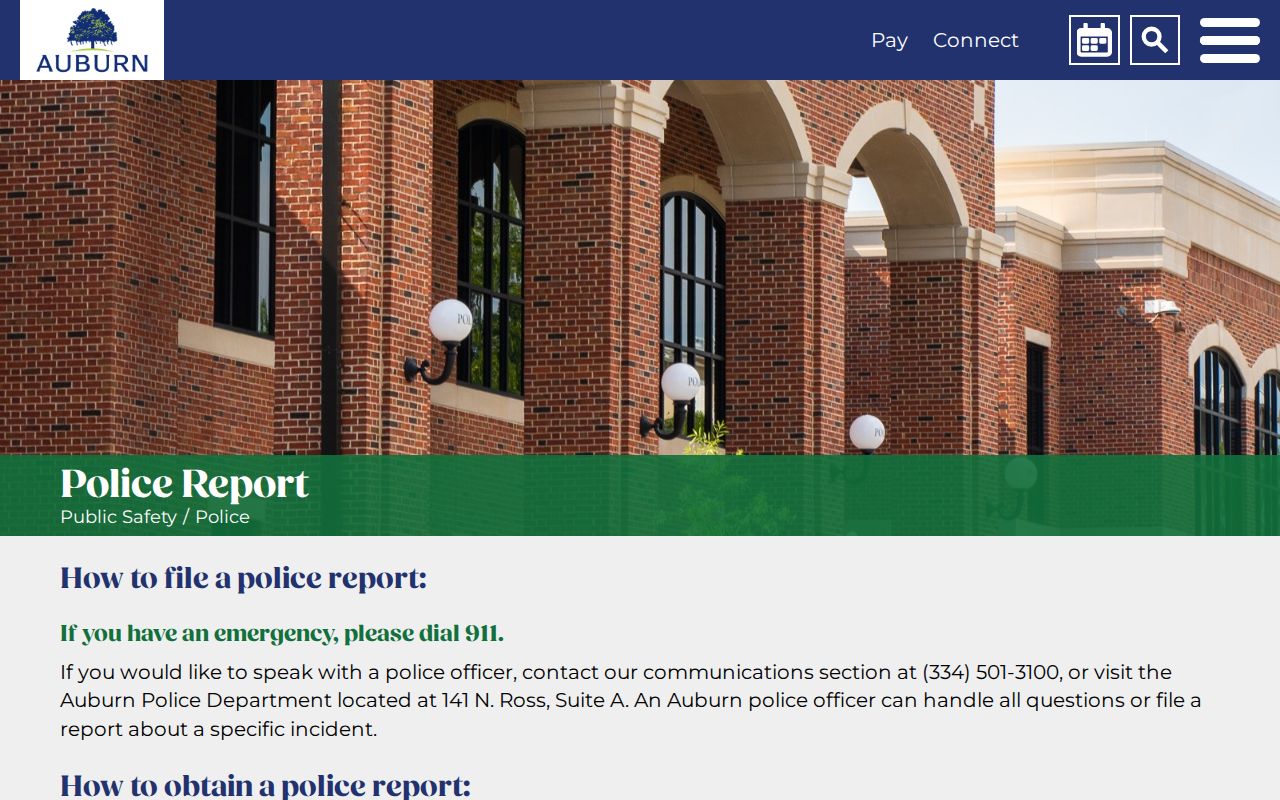
That route is broader than APD's routine report counter and requires a precise document description.
Arrests and Bookings in Auburn
APD creates the city arrest report, but Auburn does not use that report as its jail roster. A person arrested by APD is transported and booked at the Lee County Jail on Frederick Road in Opelika. Jail staff create a separate booking entry with the intake time, NameID, age, race and sex codes, charge description and status, and bond amount and status. The inspected roster does not show the arresting agency, court date, or final disposition.
For a recent Auburn arrest, check the Lee Sheriff Recent Arrests list and current Inmate Search, then contact the jail if the portal does not answer a present-custody question. Return to APD for the incident or arrest narrative. Move to Auburn Municipal Court for a qualifying city matter or to the Lee Circuit Clerk for a felony or other county case. A booking charge can change after review, so it is not proof of guilt or the last word on the filed charge.
Auburn Record Copy Fees
Auburn's fee rules depend on volume and staff effort. Ordinary paper copies cost $0.25 per page. Time-intensive work that exceeds one staff hour costs $20 per hour beginning with the second hour. If the estimate reaches $50 or more, the city may require one-half of the estimate as a deposit. These are city public-record fees, not Lee Circuit Clerk copy charges or ALEA self-review fees.
| Auburn request item | Confirmed rule |
|---|---|
| Ordinary copies | $0.25 per page |
| Staff time | $20 per hour after the first hour |
| Large estimate | Half deposit may apply at $50 or more |
| Inspection | May be required before copies; records stay in city custody |
A narrow request can reduce review time. Ask for a known report, order, or date range rather than every record that might mention a broad topic.
Auburn Municipal Court Records
Auburn Municipal Court is at 141 North Ross Street and can be reached at 334-501-3180 or webjudicial@auburnalabama.org. It hears traffic cases, city ordinance violations, and qualifying state misdemeanors adopted by ordinance. Tuesday's 9 a.m. docket includes citizen warrants and probation or general reviews. No public name or case-search form was found, so the working access channels are phone, email, the clerk counter, or a written records request.
The official Auburn court source sets out its docket and contact route.
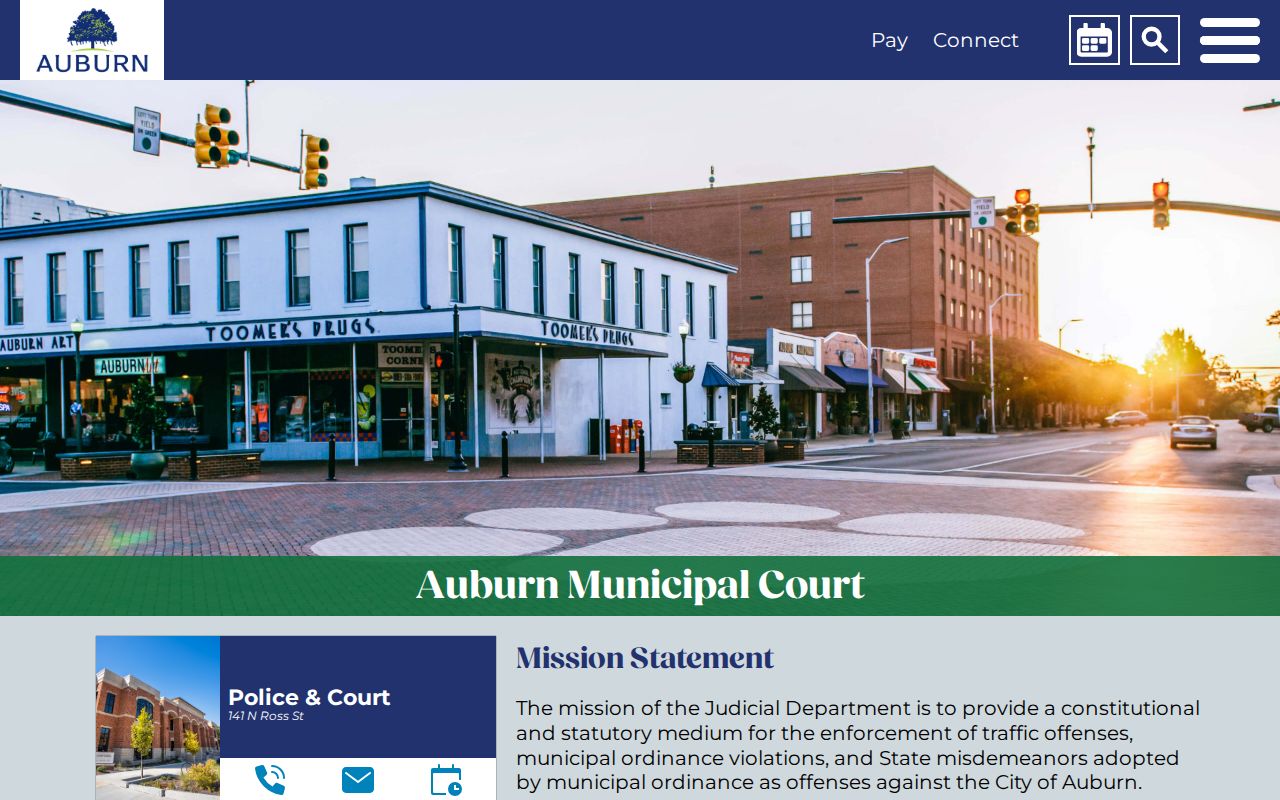
The municipal clerk holds the city case file, while jail custody and county-level cases remain in separate systems.
| Court Name | Auburn Municipal Court |
|---|---|
| Case Types Heard | Traffic, ordinance, and adopted state misdemeanor matters, plus local warrant and probation dockets |
| Case Lookup Channel | Phone, email, clerk counter, or written request; no public search portal located |
| What the Docket Shows | City charge, hearings, plea or judgment, sentence, and local financial entries when public |
| Copies & Fees | Request through the clerk; no separate municipal copy schedule was confirmed in the research |
When Auburn Records Move Countywide
The court named on a citation or case number is a better guide than an Auburn mailing address. Municipal Court handles its limited city jurisdiction. A felony belongs in Lee Circuit Court. District Court handles ordinary county misdemeanors, traffic matters, and felony preliminary hearings subject to statutory exceptions. Those county files are maintained by the Circuit Clerk at the T.K. Davis Justice Center in Opelika.
This split can produce several related Auburn records. APD may hold the report, the Lee County Jail may hold the booking card, and either Auburn Municipal Court or a Lee County court may hold the case outcome. For deeper county case access, the Lee County criminal court case record route explains the clerk and state trial-court channels. Use no more of the county system than the Auburn event requires.
Where Auburn Records End Up
An APD report begins the local paper trail. Booking at the county jail creates a separate custody record. The prosecutor and correct clerk then create the formal charge and case outcome. Fingerprints and arrest-cycle data are routed to the Alabama Law Enforcement Agency, and the later court disposition is reported back for matching to that cycle.
Record flow: Auburn Police Department › Lee County Courts › Alabama Law Enforcement Agency
Timing explains why sources may disagree. A new Auburn report can exist before a case is filed. A jail card may use an intake charge that changes. A court judgment can precede its match to the state repository. For self-review, ALEA requires fingerprints, photo identification, Form 46, and the stated state fee. It is not an open public name-search portal.
Auburn Criminal Records Context
Auburn was incorporated in 1839 and grew alongside Auburn University. The Census Bureau's 2024 estimate of 83,757 makes it Lee County's largest incorporated city. Growth and the city-campus merger help explain why one sworn city agency holds police records across settings that outsiders may expect to be separate. They do not prove that an incident occurred or establish a crime rate.
The official City of Auburn gateway supplies the municipal source shown below:

The city gateway helps locate the correct department, while the record itself must still come from APD, the municipal clerk, or the county holder.
Reading an Auburn Criminal Record
Each product answers a different question. An APD report can contain the incident number, arrest time, place, officer, narrative, initial offense, and evidence details, subject to redaction. A Lee County booking profile is narrower and focuses on custody and bond. An Auburn court file adds the city charge, docket events, plea, judgment, sentence, and financial entries. A state CHRI groups identity data, arrest cycles, and reported outcomes.
- Disposition
- The court's outcome for a charge.
- Docket
- The dated list of filings, hearings, and rulings in a case.
- Bond
- Security or conditions tied to release and appearance.
- Expungement
- Alabama's court process for removing eligible records from ordinary access.
A missing outcome may reflect lag or an unmatched report. Review the court judgment first, then use ALEA's challenge route for an inaccurate fingerprint-linked entry.
Public Access Rules for Auburn Records
Public access is tied to the custodian and the record. Auburn may inspect, redact, or withhold protected police material. Courts control their files under state statutes and judicial rules. Juvenile matters, Youthful Offender information, protected victim or minor details, expunged cases, and sealed or unserved warrants are not made public merely because someone requests them. A lawful public-record request also does not grant a right to remove originals.
Key Statutes:
Alabama Code § 36-12-40 gives Alabama citizens a right to inspect and copy public writings unless another law controls.
Alabama Code § 41-9-643 creates the individual review and challenge route for a person's own state criminal-history information.
Alabama Rules of Judicial Administration Rule 30 governs public court-record inspection, copying, and related charges.
False-pretense acquisition or unauthorized communication of criminal-offender information can carry criminal penalties under Alabama Code § 41-9-601. Ask only the proper holder for material that law permits it to release.