
Criminal Cases in the Lee County Courts
Lee County is Alabama's 37th Judicial Circuit. Circuit Court is the general-jurisdiction felony trial court and also handles lesser charges that arise from the same incident under Alabama Code Section 12-11-30. District Court handles ordinary misdemeanors, traffic matters, and felony preliminary hearings under Section 12-12-32, subject to legal exceptions. Municipal courts keep ordinance cases and qualifying traffic or misdemeanor matters within their own jurisdiction.
The Lee County Circuit Clerk is the custodian of Circuit and District case files. The public counter is Suite 104 at the T.K. Davis Justice Center, 2311 Gateway Drive, Opelika, AL 36801. It is open weekdays from 8:30 a.m. to 4:30 p.m. The main number is 334-737-3526. Filed pleadings, docket events, orders, dispositions, sentences, and court financial entries belong with the clerk, not the jail or prosecutor.
A booking card and court case may use different charge text. The jail records the intake charge. The prosecutor decides what to pursue, and the court file shows what was actually filed and how it ended. That makes the clerk record the key source for understanding a Lee County criminal case outcome.
Lee County Criminal Case Portal
Just One Look is Alabama's official on-demand trial-court access route. It offers a Name Search and a Case Number Search. A $9.99 search includes one case detail, and each additional case costs $9.99. A response stating that no records match still counts as a search. AlaCourt.com is the subscription channel for Alabama trial-court access.
The service advertises Lee County case status and basic information, court settings, actions and rulings, parties, case-action summaries, financial information, costs, and paid document images. Images cost $5 for the first 20 pages and $0.50 per page after that. The inspected Lee County case detail was behind payment, so the list describes the official product claims rather than fields copied from a private person's file.
| Search control | Type | Use | Access note |
|---|---|---|---|
| Name Search | Name mode | Find matching Alabama trial-court cases when no case number is known | A no-match still counts as the paid search |
| Case Number Search | Case-number mode | Open a known court case more directly | Confirm the number and court before purchase |
| Case detail | Paid result | Status, settings, actions, parties, summary, and financial entries | One detail is included in the initial $9.99 search |
| Document images | Paid image option | View available filed documents | $5 first 20 pages, then $0.50 per page |
The official Just One Look source shows the statewide case-access interface.
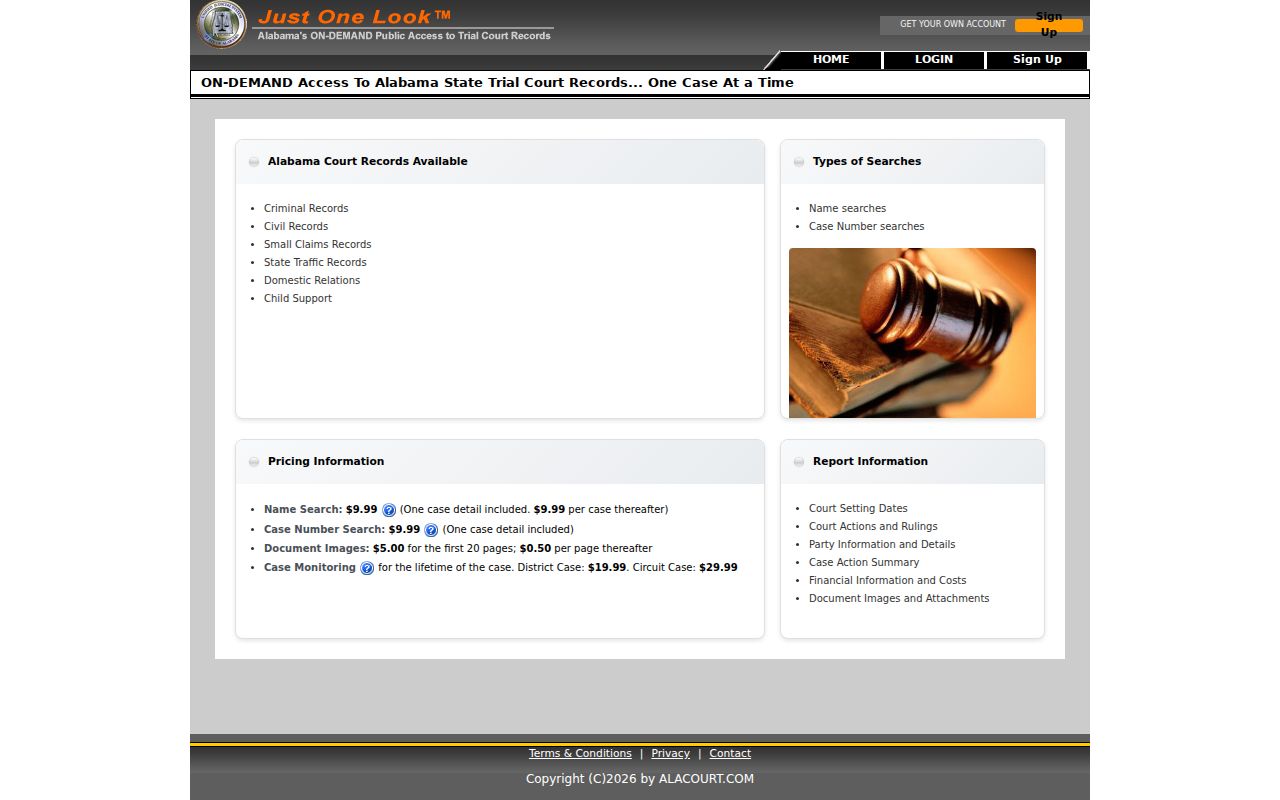
The portal is useful for remote case access, while certified copies and difficult Lee County searches still lead back to the clerk.
How to Search Case Records
Start with the most precise Lee County identifier. A complete case number reduces the chance of buying the wrong result. If only a name is known, compare the Lee County court, filing context, and other nonprivate identifiers before relying on a match. Then use the docket to locate the charging instrument, latest order, judgment, and disposition.
- Decide whether the matter belongs to Lee Circuit, Lee District, a municipal court, or federal court.
- Use Just One Look's Case Number Search when the number is known; otherwise use its Name Search carefully.
- Open the case detail and review the court, status, settings, actions, rulings, parties, and financial entries.
- Identify the exact document needed, such as the indictment, case-action summary, judgment, or last signed order.
- Send the Lee Clerk form or visit Suite 104 when a paper search, archive search, copy, or certification is required.
A no-match can mean the matter belongs to Auburn, Opelika, or Phenix City Municipal Court, uses an older Lee County paper file, has restricted access, or was filed outside Lee County. It does not prove that no related Lee County event exists.
Lee County Criminal Case Counter
The clerk directory gives direct routing that can help before a trip or mailed request. Circuit Criminal uses 334-737-3510 and 334-737-3547. District Criminal and Traffic uses 334-737-3506. District Criminal and Rapid Resolution uses 334-737-3519. The criminal front counter uses 334-737-3518 and 334-737-3504. E-Warrants and Expungements route through 334-737-3501.
Lee County Circuit Clerk
2311 Gateway Drive, Suite 104
Opelika, AL 36801
334-737-3526
Weekdays, 8:30 a.m. to 4:30 p.m.
The Lee County clerk's request form asks for requester name, telephone, address, city, state, ZIP, and email. Lee County case fields include criminal or civil, defendant name, charge, segmented case number, and date of birth. Product boxes include the last signed order, judgment, complete file, history check, dated order, warrant, indictment, and case-action summary.
| Clerk product | Lee County charge | Request note |
|---|---|---|
| Pages 1 through 20 | $25 | Copy starting charge |
| Each page after 20 | $0.50 | Added to the starting charge |
| Paper, history, closed, register, or archive search | $25 | No refund when the search finds no result |
| Certification | $5 each | Select Yes on the form when certification is needed |
No credit card or personal check is accepted for this Lee County request. Mail or deliver the form to Suite 104, allow at least seven working days, and wait for the amount due on completion. The Lee County form does not cover federal, municipal, other-county, or unrelated agency files.
Note: The clerk's separate one-to-four-business-day media target should not be promised for an ordinary case-copy request.
What the Case File Shows
A Lee County criminal case file is a chain of official court events. The complaint or indictment states the formal accusation. The docket lists filings, settings, and rulings. Pleas and motions show how the parties addressed the charge. The judgment and disposition state the legal result, while the sentence and financial entries show the court-ordered consequences.
| Case Number & Court | Identifies the court, division, filing sequence, and year used to route the file. |
|---|---|
| Charging Document | The complaint or indictment states the formal charge; it is an accusation, not a conviction. |
| Docket Entries | A dated case-action list of filings, settings, rulings, and status changes. |
| Hearing Dates | Arraignment, pretrial, plea, trial, sentencing, and other settings recorded by the court. |
| Disposition & Judgment | The outcome of each charge, such as dismissal, nolle prosequi, acquittal, or conviction. |
| Sentence & Conditions | Custody, probation, fines, fees, restitution, and other ordered terms when applicable. |
Just One Look advertises basic Lee County case data, actions, rulings, financial information, and images. A certified judgment or case-action summary from the Lee County clerk is the stronger product when the exact outcome matters. The Lee County arrest history route addresses booking and custody records, which should not be substituted for this Lee County court file.
Read Lee County Criminal Case Terms
A Lee County case-action summary becomes easier to read once a few Alabama terms are separated. A Lee County arraignment is the hearing where the charge is stated and a plea is entered. A disposition is the outcome of a charge. Nolle prosequi means the prosecutor stopped pursuing that charge. An acquittal is a not-guilty finding, while a dismissal ends the charge without a conviction.
- Indictment
- A grand jury's formal accusation that sends a felony charge forward; it is not a finding of guilt.
- Plea
- The defendant's formal response to the charge, sometimes linked to a negotiated resolution.
- Case-action summary
- The chronological court record of events, settings, filings, and rulings.
- Disposition
- The recorded outcome for a charge, which must be read charge by charge.
- Sentence
- The consequence ordered after a conviction, such as custody, probation, money obligations, or other terms.
A pending Lee County setting is not a disposition. A charge listed early in the Lee County docket may have been amended. Read through the last signed order or judgment instead of stopping at the first accusation.
Stages of a Criminal Case
A Lee County felony often begins with arrest or complaint and booking, followed by review in District Court. A preliminary hearing may address whether the felony should move forward. A grand jury can issue an indictment, after which Circuit Court handles arraignment, pretrial matters, a plea or trial, judgment, sentence, and any later appeal. A misdemeanor ordinarily remains in District Court unless a jurisdiction rule places it elsewhere.
Case flow: Charges Filed › Arraignment › Pretrial › Plea or Trial › Disposition › Sentencing
The short Lee County flow should not be read as a fixed calendar. The research provides precise early review rules, but it does not support a Lee County promise for how long each later stage takes.
Lee County Criminal Case First Hearings
Alabama Rule of Criminal Procedure 4.3 supplies two important early timing rules. A warrantless arrest requires a judicial probable-cause determination within 48 hours. A person who remains unreleased must receive an initial appearance within 72 hours. These are early safeguards, not deadlines for the whole Lee County criminal case.
At the initial Lee County stage, charge and bond information may change after judicial review. A later indictment may also differ from the jail's first wording. For that reason, use the Lee County docket and filed charging document to track the court case. The booking time alone cannot show when the case will reach plea, trial, judgment, or sentencing.
Timing point: The 48-hour rule concerns probable-cause review after a warrantless arrest; the 72-hour rule concerns initial appearance for an unreleased person.
Access & Restrictions
Alabama Code Section 36-12-40 provides a general right to inspect public writings, and Rule 30 of the Alabama Rules of Judicial Administration governs court-record inspection, copying, and charges. Those rules do not open every Lee County criminal court record. Juvenile matters, Youthful Offender information, expunged cases, sealed documents, protected victim or minor information, and identifying details removed from public views remain restricted under controlling law.
An online view can be narrower than the paper file. Ask the clerk whether a public copy exists when a case does not appear remotely. If an order has expunged the matter, ordinary access may be removed even though limited authorized disclosures remain. An unserved or sealed warrant is also outside normal public access.
The Lee County District Attorney accepts requests for records held by that office, but it directs court filings, orders, and dispositions to the Circuit Clerk. The DA open-records source makes this custody line clear.
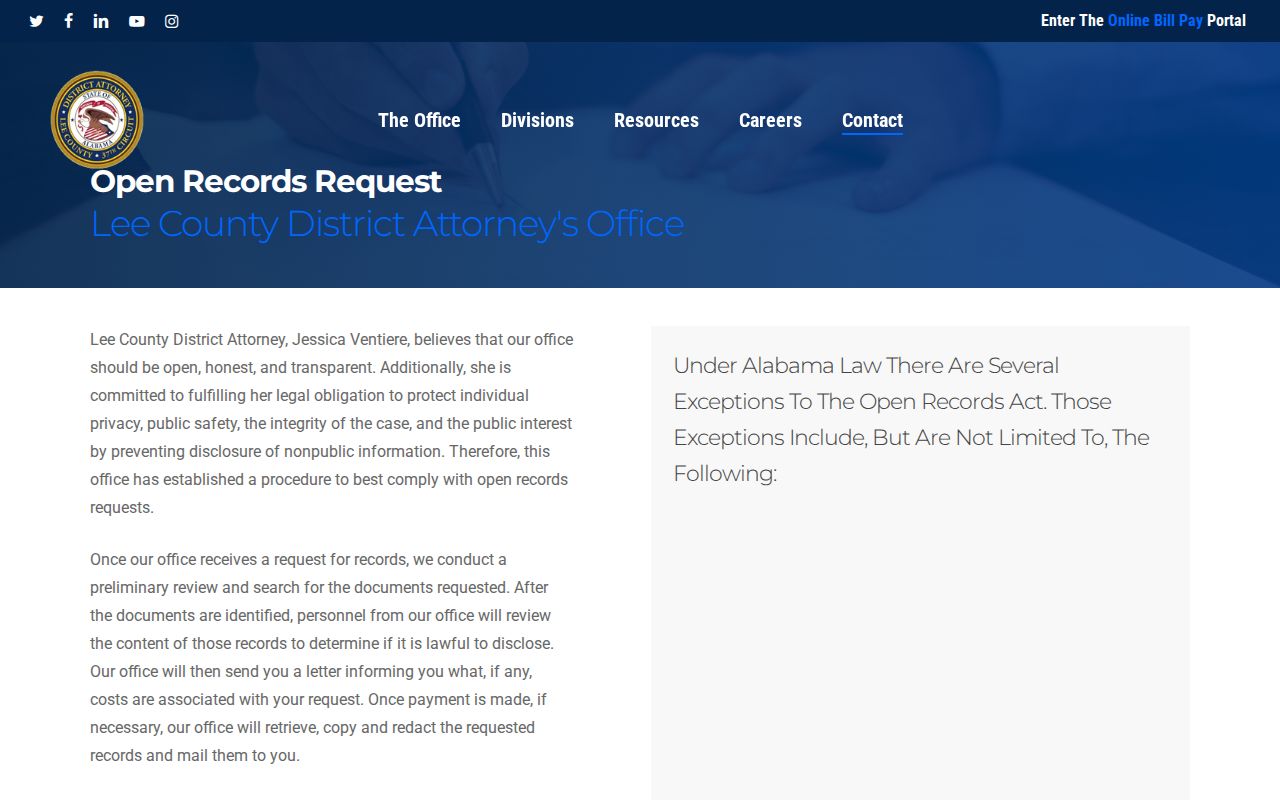
The DA process cannot replace the clerk's case file even when the prosecution office worked on the same charge.
Lee County Criminal Case Boundaries
Auburn Municipal Court at 141 North Ross Street keeps Auburn traffic, ordinance, and adopted-misdemeanor files. Its number is 334-501-3180, and no public case-search form was found. Opelika Municipal Court at 300 Martin Luther King Boulevard keeps its local matters and accepts written file requests; its number is 334-705-5190. Phenix City Municipal Court uses 1111 Broad Street and 334-448-2780.
The Lee Clerk form expressly covers Lee County, not municipal, federal, or other-county systems. When a search misses, check the issuing agency, citation, and court name before paying for another county result. Smiths Station has no separate municipal court portal in the official research, so county District or Circuit Court is the starting point based on the charge.
Federal cases from Lee County belong to the U.S. District Court for the Middle District of Alabama. The Opelika federal location is the George W. Andrews Federal Building and U.S. Courthouse, 701 Avenue A. PACER is the federal docket channel and generally charges $0.10 per page, with most documents capped at 30 billable pages and quarterly bills of $30 or less waived.
Note: Court name and case number are more reliable routing clues than the place where an arrest or booking occurred.